

Stop running stock through texts, lists, and guesswork
Bus Stash gives your team one clear system to collect requests, organize runs, and keep everything moving, without the chaos.
This is how it usually runs
On most tours, stock gets handled across a mix of texts, notes, and memory.
Someone asks for something.
Someone else says they’ll grab it.
Nobody is fully sure what actually happened.
- Requests come in from everywhere
- No clear view of what’s already handled
- Same items get requested multiple times
- Runs get pieced together on the fly
- Receipts end up scattered, or lost
Signal
The tour keeps moving whether the spreadsheet does or not, that’s when gaps show up.
It works, until it doesn’t
You can get by with texts and lists.
But as soon as things move fast, scale up, or change mid-day, it breaks down.
You spend more time coordinating than actually getting things done.
Inflection point
Friction isn’t laziness, it’s missing rails when volume and speed spike.
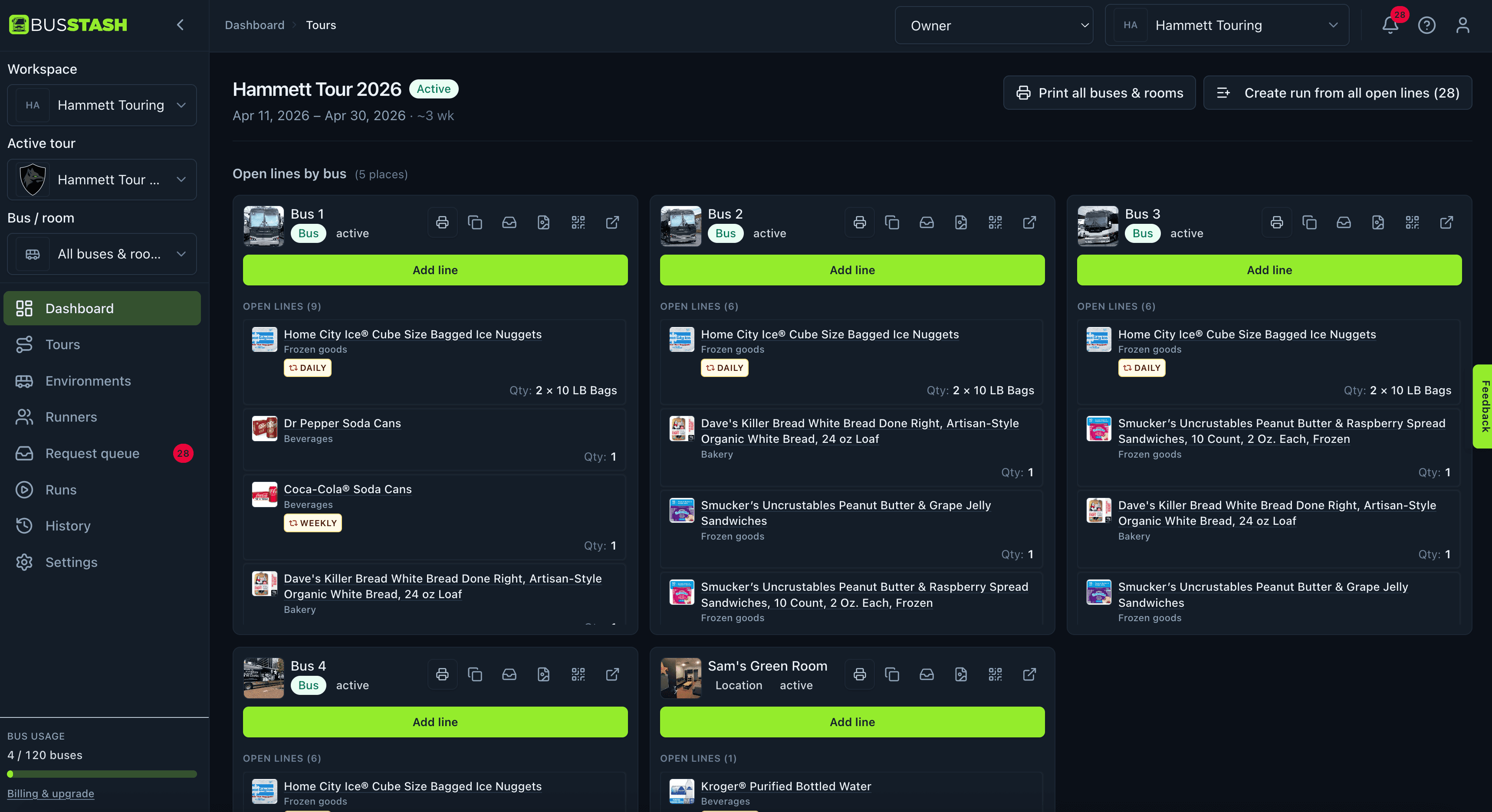
What changes with Bus Stash
Instead of managing chaos, your team runs a system.
Requests come in one way.
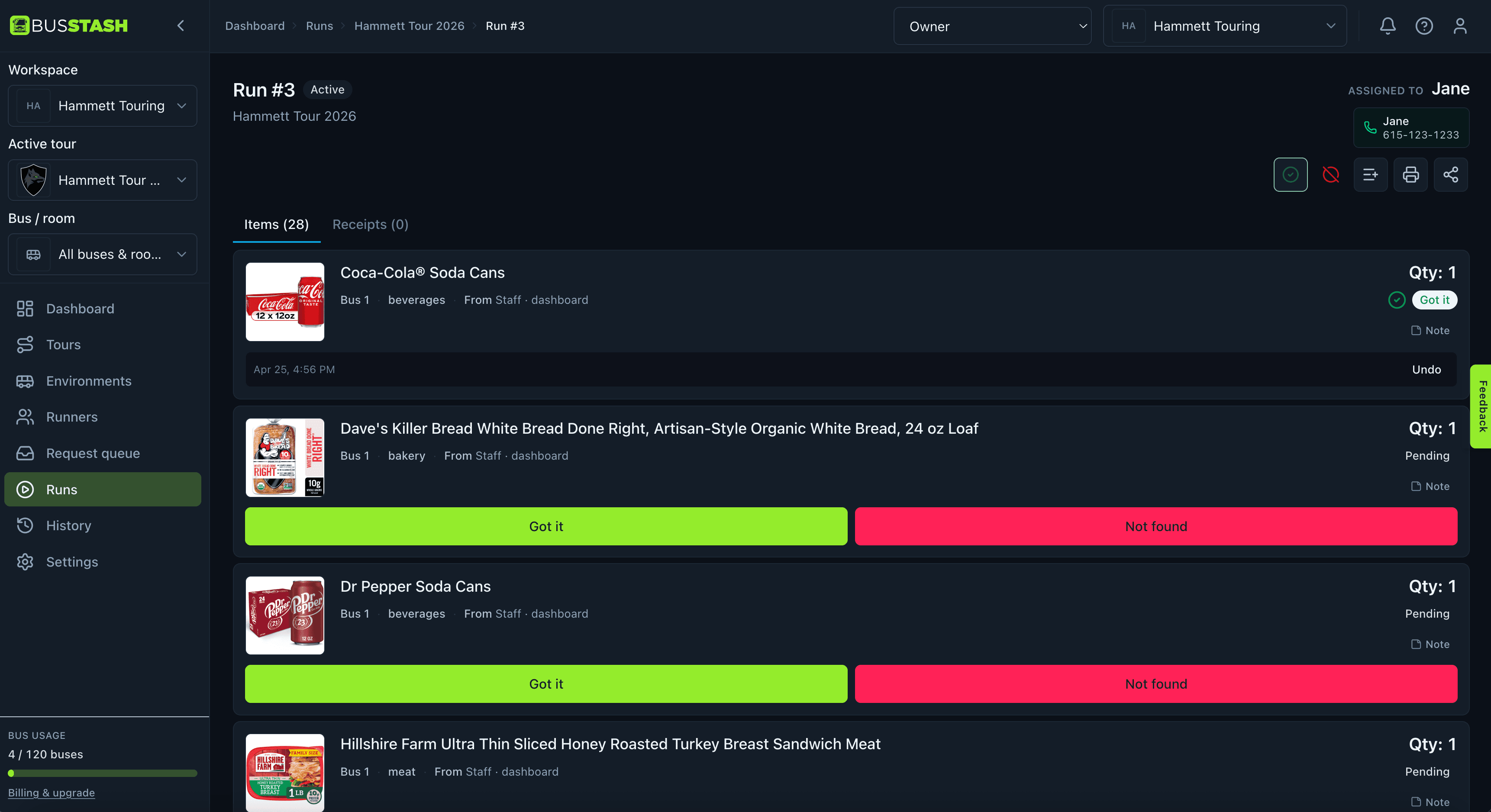
Work gets organized into runs.
Everything stays tied together from start to finish.
The move
One intake, one execution shape, one paper trail, instead of three apps and six threads.
Before vs after
On small screens, flip between the two columns. On desktop, they sit side by side.
After
- All requests in one place
- Runs are structured and assignable
- Work is clear and easy to execute
- Nothing gets double-bought or missed
- Everything is accounted for
Before
- Requests scattered across conversations
- No clear ownership
- Duplicate buying happens
- Runs feel messy
- No clean record
After
- All requests in one place
- Runs are structured and assignable
- Work is clear and easy to execute
- Nothing gets double-bought or missed
- Everything is accounted for
Not a task app. Not a spreadsheet.
Positioning
Not another task bucket, a run-shaped workflow with receipts still on the hook.
Built for runs
Work is grouped the way it actually happens, not as random tasks.
Tied to real locations
Everything is organized by bus, room, or venue.
No login required for requests
Crew can submit what they need instantly.
Execution + proof together
Runs and receipts live in the same place.
Where this makes the biggest difference
Highest ROI
When coordination is the job, giving everyone the same picture pays back immediately.
Tours with multiple buses or locations
Things break down fast without structure
Teams with multiple people handling runs
Coordination becomes the bottleneck
Fast-moving schedules
Plans change, your system needs to keep up
This isn’t about tracking, it’s about moving faster
Bus Stash doesn’t just help you keep a record.
It gives your team a faster way to collect needs, organize work, and get things done without constant back-and-forth.
Throughput
Less reconstruction after the fact, more forward motion on the next run.
Run stock like a system, not a scramble
Set up your first tour and see how quickly your team can move when everything is in one place.